Customer Interview Notes Template for Founders
A customer interview notes template for founders interviewing business buyers is one sheet per conversation with fixed fields for the last comparable purchase, the current workaround, who decides and who pays, and the agreed next step. Tag every entry as said, seen, done or assumed, write it up the same day, and roll the sheets into an evidence map before choosing where to spend time. The main constraint: an assumed entry stays assumed until new evidence arrives.
What this worksheet helps you decide
This template is for founders interviewing business buyers during customer discovery who have a handful of conversations behind them and need to decide which accounts deserve a next commercial step. It is a note-taking format, not a question list. The questions are covered in Customer Discovery Questions That Reveal Buying Intent, and running the conversation is covered in How to Run a Customer Interview Without Pitching. This page covers what to write down, how to label it and how to compare the sheets afterwards.
Interview notes usually fail in one of two ways. They turn into a transcript that nobody rereads, or into a summary in which the founder's interpretation has quietly replaced what the buyer said. Either way, the later comparison becomes unreliable. The decision the notes have to support is narrow: across the accounts you have interviewed, where does buying behavior match the interview findings, and where does it not?
The UK government's service manual page on how to analyse a research session asks teams to write exactly what they saw or heard, such as verbatim quotes or observed behaviour, not what they think it means, and to do analysis as soon as they can after each round of research. The template applies that rule to commercial discovery by giving every entry an evidence tag.
Four evidence tags
- Said. The participant told you. Use their words where you can and mark exact quotes as quotes.
- Seen. You saw it yourself, with permission: a spreadsheet, a purchase record, a whiteboard or a step of the workflow.
- Done. The account completed an action after the interview, and you checked that it happened.
- Assumed. Your interpretation, estimate or inference. Assumed entries are useful, but they stay labeled as assumptions.
When the interview did not answer a field, write unknown. An honest unknown is more useful than a plausible guess, because it tells you what the next conversation has to find out.
Header and permission fields
Start each sheet with the same header, so sheets from different weeks can be compared and shared safely inside the team.
- Account code and segment. A short code instead of the company name if the notes will circulate.
- Interview date and write-up date. Write up the same day.
- Participant role. Job title, and whether the person uses, influences, approves or pays.
- How you reached them. A warm introduction and a cold reply can produce different levels of candor.
- Interviewer and note-taker. Who asked and who wrote.
- Permissions. Whether the session was recorded, whether quotes can be shared internally and which artifacts you may keep.
GOV.UK guidance on using in-depth interviews advises getting the participant's informed consent, arranging a note-taker for each session and deciding if and how to record. A separate note-taker lets the interviewer keep listening instead of writing, and the permissions field keeps the sheet honest about what can be reused.
Fields for recent purchasing behavior
These fields record the last time the account spent money or approved a change related to the problem. Past purchases are the closest thing to buying behavior an interview can capture, so they carry the most weight in the later comparison.
| Field | What to write | Usual tag |
|---|---|---|
| Last comparable purchase | What was bought or renewed, and when, at the precision the participant gave: last spring stays last spring | Said, or Seen if a record was shown |
| Trigger | What happened that made them look at that moment | Said |
| Alternatives | What else they considered, including keeping the old process | Said |
| People | Who suggested it, who compared options, who approved and who paid, by job title | Said |
| Budget line | Which budget the money came from | Said, often unknown |
| Friction | What nearly stopped the purchase and how long approval took | Said |
| No purchase | If nothing was bought, the last attempt to change the process, where it ended and who ended it | Said |
Keep the participant's own uncertainty. If they think the owner approved it but are not sure, the entry is Said with a note, and the approver field stays open until someone confirms it.
Fields for current workaround
The workaround is what your product has to replace, so record it as a process with costs and strengths, not as a complaint.
| Field | What to write | Usual tag |
|---|---|---|
| Last occurrence | When the problem last happened and what followed, in the participant's order of events | Said |
| Steps | Each step of the current process, marking which ones you watched and which you only heard about | Seen or Said, per step |
| Tools and people | Spreadsheets, paper, messaging apps and the colleagues who get involved | Seen or Said |
| Cost | Time or money spent, with whose estimate it is and what it includes | Said, or Assumed if you calculated it |
| What works | The parts the team would want to keep | Said |
| Switching effort | What would have to change for the team to use something else | Said or Assumed |
| Artifact | What you saw or received, and what the permission covers | Seen |
Do not turn a reported hour into a promised saving inside the notes. If you want to estimate value, put the calculation on its own line tagged Assumed, next to the inputs it depends on.
Fields for the buying path and next step
The last block connects the interview to behavior that can be checked later. It separates the person with the problem from the people who decide and pay, and it keeps stated interest away from completed actions.
| Field | What to write | Usual tag |
|---|---|---|
| Decision-maker | The role that decides whether the process changes | Said until that person confirms it |
| Budget owner | The role that controls the money, if different | Said, often unknown |
| Blocker | Anyone who can stop a purchase, such as IT, procurement, a partner or a board | Said |
| Stated interest | What the participant said about solving the problem, kept in its own row | Said only |
| Agreed next step | One specific action, who does it on their side and by when | Said |
| Checked result | What happened by that date, written after you check | Done, or not done |
The stated interest row exists so that enthusiasm has somewhere to go that is not the behavior column. A participant can sound certain and still not complete the next step, and both facts belong on the sheet.
The interview evidence map
After several interviews, roll the sheets into one map with a row per account. The map is where interview findings meet buying behavior. Read across each row: the finding on the left, the behavior on the right and the gap between them.
| Column | What it holds |
|---|---|
| Account | Code, segment and participant role |
| Interview finding | The problem as described, tagged Said or Seen |
| Buying behavior | Purchases seen and next steps completed, tagged Seen or Done |
| Decision-maker and budget owner | Named roles, or unknown |
| Weakest assumption | The Assumed entry the next step depends on most |
| Next check | The cheapest action that would confirm or refute that assumption |
Do not add the tags up into a score. A row with many complaints and an unknown budget owner is not stronger than a row with a single completed introduction to the approver. The decision rule is qualitative: an account earns a commercial next step when its behavior column supports its finding on the specific uncertainty your next spend depends on.
A hypothetical filled example covering decision-maker and budget owner
The following is a hypothetical example with invented details. It illustrates the template and does not describe a real company, customer or measured result.
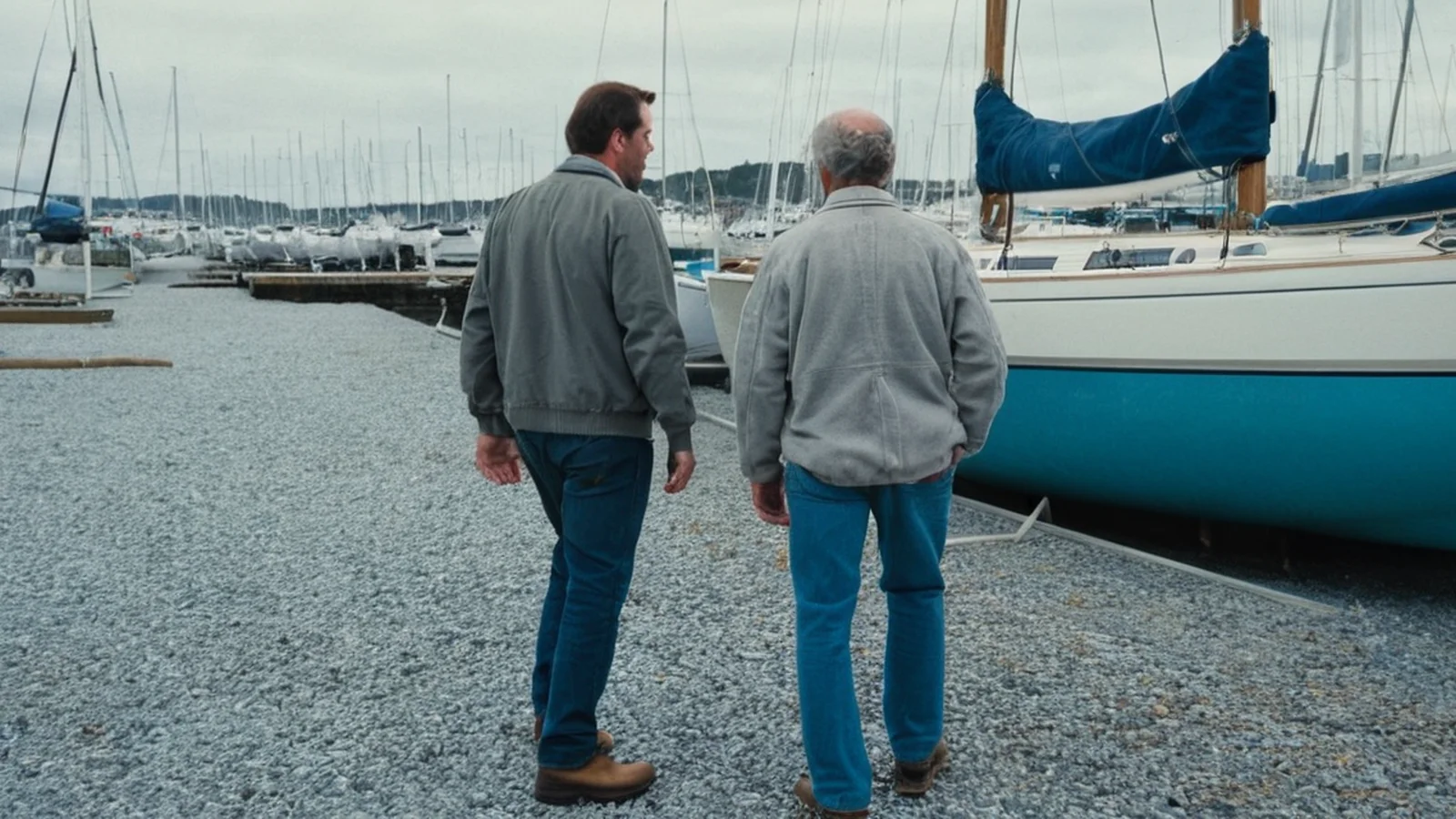
A founder is exploring scheduling software for boatyards that haul boats out of the water for repairs and winter storage. Over two weeks the founder interviews staff at three yards. At Yard B, a privately owned yard, the yard manager walks the founder between boats propped on stands to the travel lift and shows the haul-out schedule written in marker on a whiteboard inside the lift shed, with cancelled slots wiped and rewritten. The founder photographs the board with permission. The filled sheet for Yard B looks like this:
| Field | Entry | Tag |
|---|---|---|
| Participant role | Yard manager; runs the lift crew; does not sign purchases | Said |
| Last comparable purchase | A card payment terminal for the office last spring, chosen and paid for by the owner after repeated failed payments | Said |
| Decision-maker and budget owner | The owner, from the operating budget; the manager says anything with a monthly fee goes to the owner | Said |
| Last occurrence | Two boats booked into the same lift slot the previous Saturday; one boat owner waited most of the morning | Said |
| Workaround | Whiteboard in the lift shed plus a paper diary in the office, reconciled by the manager each evening | Seen for the whiteboard, Said for the evening reconciliation |
| Cost | About an hour of the manager's time each evening in season, the manager's own estimate | Said |
| Founder's reading | Double bookings happen because two people write on two different surfaces | Assumed |
| Stated interest | 'That would make Saturdays a lot calmer.' | Said |
| Agreed next step | Manager to introduce the founder to the owner within two weeks | Said |
| Checked result | Call with the owner held ten days later; the owner asked for a price and a trial before the spring launch season | Done |
The roll-up across all three yards shows why the decision-maker and the budget owner have to be recorded separately:
| Account | Interview finding | Buying behavior | Decision-maker and budget owner | Weakest assumption | Next check |
|---|---|---|---|---|---|
| Yard A, municipal marina | The harbormaster describes frequent schedule conflicts (Said) | Shared a month of the paper diary (Seen) | The harbormaster decides on operations; the money comes from the city budget, and nobody interviewed has approved software (Said; budget owner unknown) | That a purchase is possible this season | Ask the harbormaster who prepared the last budget request |
| Yard B, private yard | Double bookings and evening reconciliation (Said and Seen) | Introduced the owner; the owner asked for a price (Done) | The owner decides and pays (confirmed on the owner call) | That the owner prefers a tool to hiring seasonal office help | Offer a priced spring trial with a written success condition |
| Yard C, family yard | The owner runs the lift and says the whiteboard works (Said) | No next step requested | The owner is user, decision-maker and budget owner | That small yards have the problem at all | Pause and revisit after more small-yard interviews |
Yard A has the most vivid complaints, but the person who decides is not the person who pays, and the budget path is unknown, so its next step is a question, not an offer. Yard C's finding is useful precisely because it is negative. Yard B is the only row where behavior matches the finding and the budget owner has been heard directly, so the founder writes a priced trial offer for Yard B and lists the assumption it tests next to it. The decision rests on the checked result, not on how the interviews felt.
How to use the worksheet without treating assumptions as facts
- Write up the same day. Work from your notes and, if the participant agreed to it, the recording. Mark exact quotes; everything else is paraphrase.
- Tag at the time of writing. Change a tag only when new evidence arrives. A Said entry becomes Seen when you see the artifact, and an agreed next step becomes Done only after you check that it happened.
- Keep your reading in its own field. Interpretations are tagged Assumed and sit next to the evidence, not inside it.
- Count the unknowns before an offer. An unknown budget owner is a reason to ask another question, not to fill the cell with a guess.
- Review the map with someone else. The GOV.UK analysis guidance notes that involving more people reduces the risk of researcher bias. A co-founder or advisor reading the raw sheets can spot an Assumed entry that has drifted into the finding column.
- Collect only what was agreed. Keep account names out of files that circulate beyond the team, and keep artifacts only within the permission recorded in the header.
The template has limits. It suits products sold to identifiable organizations, where a purchase has an approver and a budget. Tags describe the type of evidence, not its truth: a spreadsheet you saw can be out of date, and a completed introduction shows access, not willingness to pay. The U.S. Small Business Administration's market research guide lists in-depth interviews among direct research methods and notes that direct research can be time consuming and expensive, which is one more reason to keep notes that can be compared later. The worksheet, tags and decision rule are an editorial framework, not a measured result.
Related guides and next step
- Choosing the questions: Customer Discovery Questions That Reveal Buying Intent
- Running the conversation: How to Run a Customer Interview Without Pitching
- Turning the evidence into a decision: Validate a Startup Idea Before Building
- Grading evidence across segments: How to Choose Your First Ideal Customer Profile
Daniel's go-to-market mentoring page describes validating the customer problem directly with buyers rather than with surveys, and describes replies, meetings, opportunities, objections and next steps being tracked by account. That account is self-reported on his site.
Bring your filled interview sheets and evidence map to a free 30-minute strategy session to review your customer discovery interviews decision with your actual evidence and constraints.
Frequently asked questions
What should a customer interview notes template include?
A header with the account code, participant role, dates and permissions, then fields for the last comparable purchase, the current workaround, the decision-maker and budget owner, stated interest, the agreed next step and the checked result. Tag every entry as said, seen, done or assumed, and write unknown when the interview did not answer a field.
What should an interview evidence map include?
One row per account with the interview finding, the buying behavior that followed, the decision-maker and budget owner, the weakest assumption and the next check. Read each row from finding to behavior, and give a commercial next step only to accounts whose behavior supports the finding.
What evidence should a founder collect for customer discovery interviews?
Specific accounts of the last comparable purchase and the last occurrence of the problem, the current workaround seen with permission where possible, the roles that decide and pay, and a dated next step that you check afterwards. Keep estimates and interpretations in separate fields tagged as assumptions.
What are common mistakes when taking customer interview notes?
Writing a summary that mixes interpretation with what the buyer said, recording enthusiasm in the same place as completed actions, guessing the budget owner instead of marking it unknown, writing up days later and adding tags into a score that hides a missing approver.