Customer Discovery Questions That Reveal Buying Intent
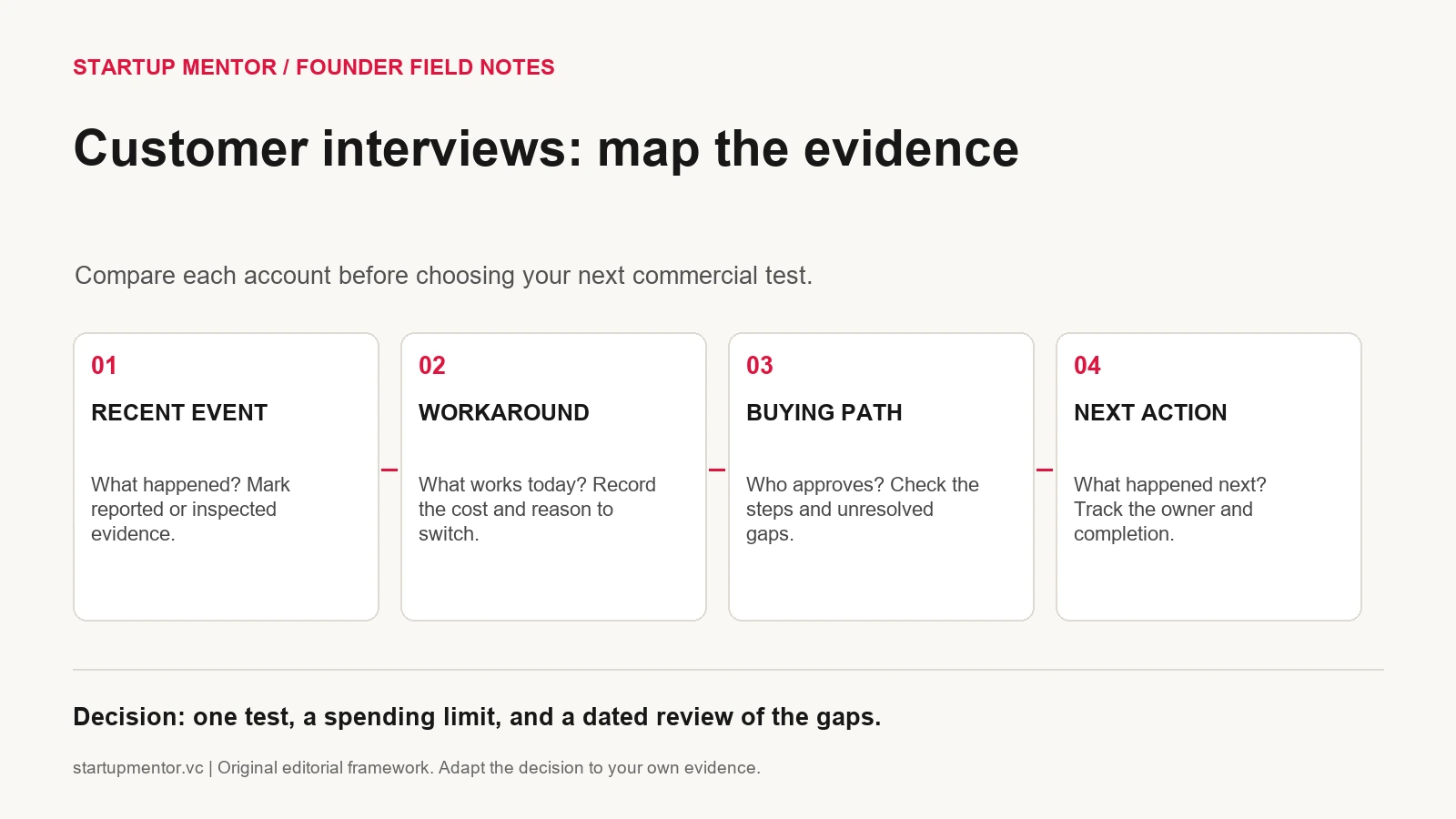
For an early B2B startup, customer discovery questions should trace a recent purchase, the current workaround, the approval process, and a concrete next step. Compare what each account reports with evidence you can inspect and actions it completes. Use the gaps to choose a limited commercial test. Interview enthusiasm alone cannot establish willingness or authority to buy.
A founder with several encouraging interviews still has to choose where to spend the next week. One account describes an expensive problem but has no purchasing authority. Another dislikes its software but just renewed the contract. A third offers a quiet introduction to the person who approves spending. The useful comparison is what each account has done, what remains unconfirmed, and which action can resolve that uncertainty.
This article offers an original editorial framework for early B2B discovery. It helps select the next commercial test. It is not a validated scoring model or a forecast of conversion. For the broader build, narrow, or stop decision, use the startup idea validation worksheet.
The choice and its business consequences
Decide which uncertainty the interviews must resolve before arranging another round. If the next expense is an integration, ask whether a buyer can authorize a test requiring that integration. If the next expense is sales outreach, ask which buying situation deserves more conversations. Evidence adequate for a follow-up meeting can be inadequate for hiring an engineer.
Keep three types of information separate in your notes: what the participant reports, what you inspect with permission, and what happens after the call. A reported purchase is useful history. A redacted purchase record can corroborate it. Neither establishes that the account will buy your offer.
GOV.UK's interview guidance recommends open, neutral questions and specific stories, with follow-ups to clarify answers. The questions below apply that interviewing approach to a commercial decision. Ask them in the participant's vocabulary, and let the account's actual process determine the order.
Recent purchasing behavior
Start with a comparable decision the participant remembers. The purchase need not be in your exact product category. It should involve a similar expense, workflow change, or approval path.
- What was the last tool or service you bought to handle this work?
- What happened that made you look for it then?
- Which alternatives did you consider, including keeping the existing process?
- Who first suggested spending money, and what happened before approval?
- What nearly stopped the purchase?
Follow the sequence from the original incident to the final decision. Record dates as precisely as the participant can recall, and mark estimates as estimates. A purchase made during an emergency may tell you little about the ordinary budget cycle. Ask what would be different today.
If nothing was purchased, examine the last serious attempt to change the process. Find out where it ended and who ended it. A rejected proposal can identify an approval obstacle. The absence of any attempt leaves urgency unresolved, even when the interview contains detailed complaints.
Current workaround
Ask the participant to walk through the most recent occurrence of the task. Request an anonymized example only when it is useful and they are authorized to share it. A verbal walkthrough is acceptable when the underlying material is confidential.
- How did you complete this task last time?
- Where did someone have to step in or redo work?
- What happened because of that delay or mistake?
- What works well enough that you would want to keep it?
- What would your team have to change to use a different approach?
Keep costs grounded in the account's evidence. If a participant estimates time spent, record whose estimate it is and which tasks it includes. Avoid converting every reported hour into a promised saving. Some effort remains after a product is introduced, and saved employee time does not automatically release a cash budget.
Include the workaround's advantages. A spreadsheet can be familiar, flexible, and already approved. Your test must address a reason to change that outweighs the disruption. A strong complaint paired with an acceptable workaround can justify more investigation without justifying development.
Decision-maker and budget owner
Y Combinator's user observation guide distinguishes users from customers and recommends deciding what the observation needs to validate. Apply that distinction when the person experiencing the problem cannot approve spending.
- Who approved the last comparable purchase?
- Which budget paid for it?
- Who else reviewed the decision, and what did they need to see?
- What competing work is taking priority now?
- Who could explain the approval process if the details have changed?
Ask about actual approval history before asking whether a budget is available. A participant's belief that a director will support the purchase belongs in the unconfirmed column until the director participates or the process supplies other evidence. A named budget owner is a contact to understand, not a completed sale.
Daniel Tonkopiy's published GTM method begins with a narrow customer profile, a buying trigger, and the decision-maker. Here, those choices become account-level questions. Keep the discovery conversation useful even when the person cannot buy: they may explain the workflow well while leaving the commercial decision unanswered.
Interview evidence map: compare accounts without hiding gaps
Copy this table once per account. Add the interview date and participant's role above it. In each evidence cell, label the entry reported, inspected, or completed. Record an explicit unknown when the interview does not answer a question. Do not total the rows into a buying-intent score: a large number of complaints cannot compensate for an unresolved purchasing constraint.
| Question to resolve | Evidence and its status | Contradiction or gap | Next check |
|---|---|---|---|
| Why would this account act now? | Recent incident, date, and consequence | Is the problem recurring or exceptional? | Ask about another occurrence or a real deadline |
| What must the offer replace? | Current workflow and stated spending | What does the workaround still do well? | Walk through a permitted example |
| Can someone approve a purchase? | Prior approval steps and named budget owner | Has that person confirmed the path? | Request a relevant introduction |
| Will the account take a next step? | Agreed action, owner, date, and completion | Is the action tied to the proposed purchase? | Check the agreed result on the review date |
| What spending does this evidence justify? | Specific test and founder effort limit | Which assumption could still invalidate it? | Write the condition for continuing or pausing |
After the research portion, ask permission to discuss a possible next step. Explain the proposed scope honestly, including manual work and unavailable capabilities. Choose an action that tests the missing assumption: a budget-owner conversation, a procurement requirements check, or a clearly priced pilot offer. Record a declined invitation without pressuring the participant.
A completed introduction shows access. It does not show willingness to pay. A purchase shows acceptance of that offer under those terms, while repeat usage and delivery economics remain separate questions. Compare accounts on the uncertainty your next investment depends on.
A worked decision with explicit assumptions
Hypothetical example: a founder is exploring a tool that gathers missing documents for small accounting firms. All firms, amounts, timings, and actions here are invented. Assume the founder can spend 12 hours on one commercial test this week, has no integration built, and can run a manual test using authorized sample data.
Firm A reports ten hours of chasing documents each week. Its team likes a demo, but the interviewee does not know who could approve new software. Firm B reports four hours a week and recently paid for a workaround. Its partner joins a follow-up call and explains the approval steps. Firm C reports a similar burden but has just renewed a satisfactory service and declines further discussion.
The founder chooses Firm B for the limited test. The decision rests on a completed purchasing conversation and relevant purchase history. Firm A's larger reported burden remains worth checking, but it has not established a buying path. Firm C's existing arrangement gives the founder a reason to pause pursuit for now.
The next offer is a one-week manual pilot for $300 with a defined document set, an agreed output, and a six-hour delivery cap. These are illustrative terms, not recommended market prices. The founder asks the partner to confirm the terms and permitted inputs before starting. No acceptance has yet occurred, so the current evidence supports making the offer, not calling the account a customer.
If the partner declines, record the reason and revisit the assumption it contradicts. If the offer is accepted, measure actual delivery effort and whether the output is used. Neither outcome alone establishes a market for a general software platform.
Close the comparison with a dated decision
Choose one account and one next check, then state why the evidence supports that allocation of time. Give the check an owner, a review date, and a spending limit. Keep the strongest contrary evidence beside the decision so it survives the next enthusiastic conversation.
Bring your completed evidence maps, competing accounts, and proposed test to a Startup Mentor strategy session. Use the session to examine the purchasing assumption behind your next investment and decide which evidence to collect next.
Frequently asked questions
What should an interview evidence map include?
Record the account, participant role, interview date, recent incident, workaround, purchasing path, and next action. Label each piece of evidence reported, inspected, or completed. Keep contradictions and unknowns visible, and connect the next check to a specific spending decision.
What evidence should a founder collect in customer discovery interviews?
Collect specific accounts of recent work and comparable purchases, then seek permission to inspect relevant examples. Record who approves spending and what actions happen after the interview. Keep estimates separate from measured costs, and collect only information the participant is authorized to share.
What are common mistakes in customer discovery interviews?
Common mistakes include leading with the product pitch, treating hypothetical purchase answers as commitments, confusing the user with the budget owner, and recording complaints without examining the current alternative. Use a recent event and a comparable purchase to make follow-up questions concrete.
Does an introduction to a budget owner prove buying intent?
A completed introduction establishes access to a relevant person. It leaves willingness to pay, scope, timing, and approval conditions unresolved. Use the conversation to check those assumptions before committing development effort.